
Are You a Workaholic? A Founder's Guide to Switching Off Without Losing Momentum
It starts innocently. You open the laptop after dinner to "just finish one thing". Then it's midnight, you're still replying to messages, and your brain is running like a browser with 47 tabs open.
The dictionary definition of a workaholic is someone who "works a lot". That's a pretty vague definition. For Founders and Cofounders, it's usually more specific: you're not only working hard, but you're also struggling to stop. When you are at the helm, it just feels so hard to go below and grab some shut-eye. It is what makes the difference between a job and a passion, and that matters. But unless we can find the moments to pause, we do real damage to our health, our relationships, and our judgment when pressure hits.
This post gives you a quick self-check, a look at the hidden costs (especially sleep), and a practical reset plan built on small habits: music, movement, food, and journalling. If you want a ready-made structure to help you stick with new routines, you can grab FounderThrive here.
The quick self-check: when hard work turns into "can't switch off"
Working long hours isn't automatically a problem. Sometimes it's the right call, like a launch week, a major hire, or a time-sensitive fundraise. The red flag is when "busy" becomes your default identity, and rest starts to feel unsafe.
A simple way to spot the line is to look for compulsion rather than effort. A healthy effort has a clear purpose and an endpoint. Workaholic mode feels like you're chasing relief, control, or approval, but the finish line keeps moving.
Use this quick scoring check. Give yourself 0 to 2 for each statement (0 = rarely, 1 = sometimes, 2 = often). Total it up at the end.
Before the table, one note on context: if your score spikes during a two-week sprint but settles after, that's normal stress. If it stays high for months, it's a pattern.
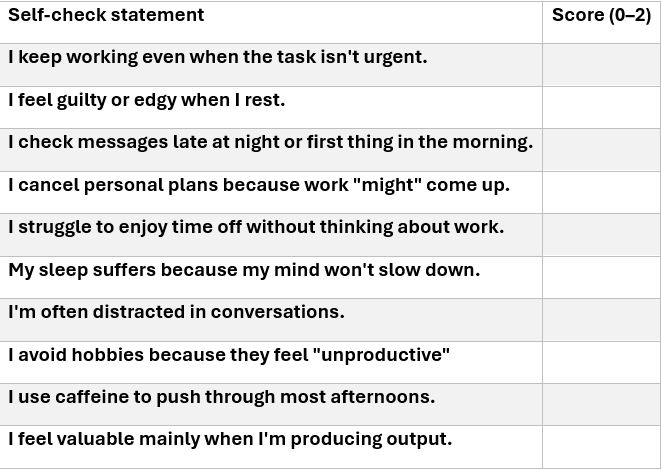
As a rough guide, 0 to 6 suggests you're probably in a tough season, but still in control. 7 to 13 points to a drift that's worth addressing. 14 to 20 usually means work is starting to run you, not the other way round.
If rest creates anxiety, it's rarely about the diary. It's often about what silence brings up.
Signs you might be slipping into workaholic mode
You don't need all of these to be "a workaholic". One or two can be enough to prompt a reset.
Guilt when resting: You sit down, but your mind keeps arguing with you.
Checking messages in bed: Slack, email, WhatsApp, and LinkedIn, then suddenly it's 1 am.
Always "on call": Even when no one asked you to be.
Skipping meals: You forget food until you're shaky or snappy.
Cancelling movement: Exercise becomes "something I'll restart next week".
Irritability and short fuse: Small blockers feel personal.
Loss of hobbies: You stop doing things with no obvious payoff.
Not present with family or friends: You hear them, but you're elsewhere.
Anxiety when the diary is empty: Blank space feels like failure.
Founder-specific tells: Refreshing the fundraising deck at 11 pm or jumping into every product fire because "it'll be quicker if I do it".
A simple boundary test: if you stopped for 48 hours, what would break?
This question isn't about taking two days off tomorrow. It's about separating real business risk from imagined risk.
Grab a note and split it into two columns:
"Only I can do this"
"Someone else could do this, with support"
Now be ruthless. If you're honest, a lot of tasks sit in the second column, but you've kept them because delegation feels slower, or because you're the default decision maker.
A classic single point of failure looks like this: the Founder is the only person who can approve pricing exceptions. Sales stalls without them, so they keep checking messages at night "just in case". The fix is not heroic stamina. It's to establish a simple rule set, a documented approval range, and one trained back-up.
The goal is continuity, not control. When the business can breathe without you for 48 hours, your work-life balance stops feeling like a luxury.
What constant work is really doing to your brain, sleep, and judgment
A lot of high performers, much like the salesman relentlessly pitching the next best thing before transforming that grind into monumental success, treat sleep as optional, then try to buy it back later. That tends to fail, because sleep is not a bank account. It's a daily biological process that keeps your brain steady.
One useful concept is sleep pressure. As you stay awake, a chemical signal builds in the brain that increases the drive to sleep. During sleep, that signal clears. Caffeine works by blocking the receptors involved, which can make you feel alert, but it doesn't remove the underlying pressure. That's why late caffeine can leave you tired, wired, and annoyed at yourself.
There's also a psychological trap: the harder you try to sleep, the more awake you can become. Sleep isn't something you can force by effort. It responds to cues, routine, and a calm nervous system.
Chronic insomnia is more than "a few bad nights". Clinical definitions often focus on problems falling asleep, staying asleep, or waking early, occurring at least 3 nights a week for 3 months, plus daytime impact. It's common, and it's not trivial. Research links poor sleep to increased inflammation, weaker immune function, and faster markers of brain ageing. Insomnia also raises the risk of depression, and it's associated with higher chances of long-term issues like high blood pressure, heart disease, and type 2 diabetes. There's even evidence that persistent insomnia symptoms track with a higher risk of dying earlier over long follow-ups.
For a Founder whose cognitive performance hinges on clear thinking, the day-to-day cost shows up first as judgment. You lose the precision and focus needed to navigate a business deal. You get more reactive—your memory slips. You miss details in contracts. Conflict escalates faster. In short, the very thing you think you're protecting by working more starts to wobble.
Why "I'll catch up on sleep later" usually backfires
The body needs a steady rhythm. If you keep pushing bedtime later and lie in at weekends, your sleep drive can get messed up. You end up tired at the wrong time and alert when you want to switch off.
Another issue is what happens when you spend lots of time in bed awake. Over time, the brain can start to link the bed with wakefulness and problem-solving. That's one reason insomnia can stick around.
A practical takeaway that helps many people is simple: establish a consistent wake time, and keep the bed mainly for sleep (and sex). If you're routinely awake in bed for long stretches, it's a sign you need to establish adjustments to your routine, not that you should "try harder".
Insomnia, stress, and the spiral that keeps you switched on
Overwork often triggers stress. Stress disrupts sleep. Then poor sleep reduces your ability to handle stress, so you work longer to compensate. The spiral tightens.
The good news is that behavioural support can work extremely well. Cognitive Behavioural Therapy for Insomnia (CBT-I) has a strong evidence base. Large reviews show most people who try CBT-I improve, and a significant share reach full remission. Access can be the sticking point, because there aren't enough trained therapists to meet demand. That's why digital CBT-I has grown, including programmes that have been tested in clinical trials and approved by UK health bodies.
If your sleep is consistently poor, it's worth taking seriously. Not because you're broken, but because sleep sits under everything else you're trying to build.
A FounderThrive-style reset plan that still respects ambition
Work-life balance can sound like a moral lesson. In practice, it's a performance advantage. It protects your decision-making, your relationships, and your stamina when the business tests you.
This reset plan is built for the busy Founder's weeks. It's not an all-or-nothing makeover. Think of it like tightening a few bolts on a bike so the ride stops wobbling, while still respecting the ambition.
If you like building habits with a bit of structure, the FounderThrive app is designed around simple pillars, including sleep, nutrition, movement, and mind-body support. The point is consistency, not perfection.
Downshift fast with chill music and a simple shutdown ritual
Your brain needs a clear "work is done" cue. Without one, you carry work into the evening, then into bed.
Try this 15-minute shutdown:
Close the loop list (10 minutes): write every open task in one place. Don't organise it yet, capture it.
Pick tomorrow's top three (2 minutes): choose the three moves that would make the day feel like progress.
Chill music plus a physical cue (3 minutes): play a calm track while you tidy your desk, wash your mug, or do a short stretch.
Rituals work because they create repeatable signals, much like franchising a proven system. Over time, your nervous system learns the pattern, and switching off gets easier.
One evening tip: keep your calm playlist for the last 30 to 45 minutes before bed. Use it as a boundary, not background noise.
One post-meeting tip: after an intense call, take two minutes before your next task. Stand up, slow your breathing, and let your shoulders drop. That tiny gap can stop the day from becoming one long stress chain.
Schedule movement like a meeting, and make it embarrassingly easy
Most Founders don't need a motivational speech. They need a plan that survives chaos.
Pick one of these and put it in your calendar:
A 20-minute brisk walk after stand-up or after the school drop-off.
A 10-minute strength circuit between blocks of calls.
A 5-minute mobility reset before lunch, especially on heavy screen days.
The trick is a time trigger, not willpower. If the trigger happens, you do the movement. On chaos days, the minimum still counts. Five minutes keeps the habit alive, and that matters more than a perfect session once a fortnight.
Eat properly so you stop running on caffeine and adrenaline
When food becomes random, your mood follows. Blood sugar swings can mimic anxiety, and they can make you more reactive in meetings.
Keep it basic: aim for regular meals, and build each one around protein plus fibre. Add water early in the day, not only when you remember at 4 pm.
Caffeine is personal, but timing matters. If late-day coffee hurts your sleep, move it earlier. Better sleep makes the next day easier, so you need less caffeine anyway.
A simple "Founder desk drawer" back-up helps when the day goes sideways:
nuts or mixed seeds
oatcakes
tuna or salmon pouches
protein bars with low added sugar
dried fruit (paired with nuts, not alone)
This isn't about being strict. It's about avoiding the crash from fast food that turns a normal afternoon into a second-rate crisis.
Journal to clear mental tabs, reduce 2 am problem-solving, and spot patterns.
If your brain tries to solve problems at 2 am, it's often because it didn't get closure at 10 pm.
A three-minute nightly journal can help. Set a timer, write fast, and stop when it ends. Use prompts like:
"What am I carrying?" (worries, decisions, unresolved conversations)
"What can wait?" (name what you're not doing tonight)
"What did I do well today?" (one win, even if it's small)
You're not writing a memoir. You're clearing mental space. Over time, this also shows patterns, like which meetings spike stress, or which habits improve sleep most.
Conclusion
Being a committed Founder isn't the same as being trapped in work. Persistence is the positive trait every company founder should keep while letting go of workaholism.
If you recognised yourself in the self-check, start small. Choose one habit from the reset plan and do it for seven days, even if it's the minimum version. That's often enough to break the "can't switch off" loop and make work-life balance feel practical again.
If you want extra support and a simple place to track the basics, you can download FounderThrive here: https://qrco.de/bgPG9m. The best test is simple: when you stop for an hour, do you come back sharper, or more stressed?
