
I answered in a heartbeat. Who’s your favourite character – Richie, hands down. He has heart; he has pain; he becomes the professional that everyone respects.
With so many to choose from, Richie just is that one. I love Carmy, Syd and Marcus, who all shone and Tina, who couldn’t warm to her growth and love for everything and everyone around her. It is Richie that does it for me. It was his journey from angry resistor to the one who saw that The Bear was not just food and place; it was family.
“If we’re going to invite people into our home, we’re gonna look like a fucking family.” – he not only said it, he made it happen.

GIF supplied by Giphy
There are moments in the entire series when it simply does not gel, but you can forgive that because they are so few, and the recovery comes so quickly. We live in chaotic times, mirrored here; we go from one paycheck to the next, at times forgoing the good times to simply hang on. That’s The Bear, a big, juicy, wagyu steak of a metaphor for life.
By Series Five, The Bear has become far more than a story about food, pressure and a restaurant in Chicago. Its lasting force lies in watching people learn that talent means little without trust, timing and a shared commitment to one another.
You may be sitting in a corporate job or facing redundancy. Your options are looking pretty thin, but it comes to you. How about being a founder? You begin by building the blueprints on a train, designing a company around your own drive, judgement and stamina. Yet all this passion eschews the idea of what it would take. You can do the hard work because it’s meaningful stuff, your chance to do something new and inspiring. who can carry the mission together. I’ve been there, and I know, the first steps are the most scary.
That is why The Bear feels so close to the ambition behind our own venture, The Weave. I don’t think I have ever watched a TV series where everything was just like, so, that’s how I am meant to feel, to fight the doubters and stand behind the passion for the vision.
The Bear Shows That Excellence Belongs to the Whole System
Carmy lives up his own arse sometime and in the beginning, he may be the most visibly gifted chef, but he realises by the end that he cannot create The Bear alone. The restaurant only begins to feel complete when every person has room to become more capable. Tina, God love her, she steps out of that ring of self-doubt, and Syd bestows her with praise and a promotion, that lights up her eyes, and you see that belief for real.
Sydney develops her voice because people eventually treat her judgement as essential. Marcus turns grief into care for his work. That one moment when he served the caramel sauce to his doubtful father from the candle, as he cut it in half and drizzled its contents onto the dessert. That is how surprise and beauty coexist in the perfect customer moment. Natalie (Sugar) carries difficult operational weight because the people around her recognise what she holds. She is in that office for a reason, in that space because everyone needs her to be.
It is Richie, who discovers dignity when somebody trusts him with a standard worth meeting, that I felt the most connected to. His journey felt like a beautiful love song to Chicago, to the people around him, to his daughter and finally to Jessica, perhaps the most remarkable professional who held the keys to his development and who eventually passed those skills onto Richie.
The restaurant becomes the central character because the people within it make one another better. Each person's progress changes what the whole team can do.
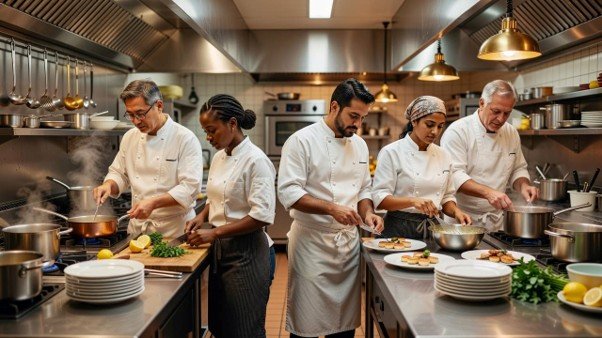
A kitchen but not The Bear Kitchen
The founder's mission eventually became the mission of The Bear, shifting responsibility from one person to many. A business can begin with one person's energy, but lasting excellence comes through relationships, shared habits and clear systems. Forbes' reflections on leadership and teamwork in The Bear make a similar point: adaptability and teamwork matter when pressure rises.
The Weave is built around this belief. It is a constellation where founders can build capacity alongside one another, rather than simply consume advice inside a programme. In The Weave, we live experience to develop skills.
People grow when the system gives them room
At the start, Carmy's instinct is to control each plate, decision and detail; by the end, he acknowledges that micro-management just does not work; it makes everybody around him smaller. People wait for instructions, protect themselves from criticism and stop bringing their full judgement to the room.
The restaurant starts to breathe when others make decisions. Sydney can lead. Richie can anticipate needs. Tina can teach. Marcus can bring his own curiosity to the work. These are not acts of rebellion. They are signs that trust has become real.
Founders often face the same test. If every important decision must pass through one person, the organisation has a bottleneck, not a leadership structure. Strong systems distribute responsibility without abandoning standards.
The point of leadership is not to remain indispensable. It is to help other people become capable.
Shared ownership needs more than good intentions. It needs honest expectations, authority matched to responsibility and room for people to learn through judgement. That is stewardship: caring for the whole without needing to possess every part.
The founder's role changes from hero to gardener
Early-stage founders have to protect the work. They set direction, make hard calls and often carry risks others cannot yet see. However, a founder who keeps playing every role eventually limits the company they created.
The later work looks more like gardening. You tend the conditions. You protect standards. You remove obstacles. You notice who needs challenge, support or a clearer brief. Then you allow people to grow in ways you could not have planned yourself.
A mission becomes durable when it lives in shared decisions, working practices and relationships. It cannot sit only in the founder's head. The real measure of leadership is whether the culture holds when that person is absent.
That is central to The Weave's mission for founders. The aim is to support people as whole human beings, because businesses reveal the quality of the people and relationships behind them.
What The Bear Teaches Founders About Better Organisations
The Bear never pretends that competence removes chaos. Equipment fails. Money remains tight. People bring stress, grief and old wounds into the kitchen. A packed service still creates problems that no plan can fully prevent.
Founders often wait for a future point when things settle down. That point rarely arrives. The work is to build routines and relationships that create care amid uncertainty.
The Lean Enterprise Institute's look at time management in The Bear connects kitchen pressure with collaborative problem-solving. Good systems do not remove every problem. They make problems easier to see, discuss and resolve before they become personal blame.
High standards are a form of respect
The Bear's standards matter because guests notice the details, and because the team wants to take pride in its work. That is different from perfectionism used as a weapon.
Harmful perfectionism says that any mistake proves someone is inadequate. Craftsmanship asks people to keep improving, then gives them the tools, time and feedback to do so. One produces fear. The other builds capability.
High standards can be an act of respect for customers, colleagues and the work itself. Lowering expectations whenever people feel tired may feel kind, but it can also tell the team that their best work is beyond reach.
The better response is practical. Reduce needless friction. Clarify the brief. Train people properly. Fix broken handovers. Protect time for preparation. Then hold the line on what good looks like.
Conflict reveals where growth is needed
Conflict fills The Bear because its characters care, often without knowing how to say so safely. Their arguments expose poor communication, uneven responsibility and pain that has not found a place to go.
That does not make every confrontation healthy. Shouting, humiliation and fear damage people. Workplace lessons drawn from The Bear also point to serious concerns around toxic leadership and wellbeing.
Yet disagreement itself is not evidence that an organisation has failed. Indifference is often more dangerous. A team that can name tension can repair it, provided people accept responsibility and stay focused on the shared purpose.
Founders need places where difficult information can surface early. When a colleague says a process is failing, or a decision has caused harm, the response sets the tone. Curiosity creates learning. Defensiveness teaches people to stay silent.
Service gives ambition a clearer purpose
The restaurant changes when it stops treating every service as proof of Carmy's worth. The guest becomes the focus. A plate matters because somebody receives it, remembers it and feels cared for.
Businesses need that same shift. A founder can spend years trying to prove they are successful, original or important. Those motives may drive early effort, but they are a weak foundation for a long-term organisation.
Purpose becomes clearer when the question changes to: who are we here to help, and what would meaningful help require? For The Weave, that means founders who need practical support, trusted relationships and space to grow without performing certainty.
Hospitality leadership lessons from The Bear also stress how purpose and investment in people improve engagement. When people understand who benefits from their work, quality gains a human reason.
The Weave Is the Organisation Beneath The Bear
The Weave is not defined by a single format. It is more than an incubator, consultancy, membership offer or conventional networking group. Its value comes from connections between people whose individual progress strengthens the group.
A good organisation works like an ensemble. People know the shared score, but they also listen closely enough to respond when someone changes pace. They anticipate needs. They cover gaps. They challenge one another without losing sight of the work.
That requires trust, shared standards and repeated contact. It also requires founders willing to let credit travel. The Weave founder community creates space for those relationships to form through support, conversation and practical encouragement.
Success becomes collective, not personal
The hardest shift for a founder may be releasing the sentence, "Look what I built." It often carried them through the difficult early years. However, it can become too small for what the organisation needs next.
Collective success sounds different: "Look what we can create together." It gives people permission to contribute ideas, take responsibility and own outcomes. It also asks the original founder to share power and accept that others may improve the work.
The strongest systems do not erase individual talent. They put talent in relationship with other talent. Carmy's skill matters. Sydney's vision matters. Richie's transformation matters. None carries the restaurant alone.
Legacy is built through the next service
The Bear avoids a simple final victory because the work never ends with applause. Recognition may arrive, but dinner still needs to be served. The team still needs to listen, prepare and show up for each other.
That is how legacy develops. It lives in small acts of care, sound judgement and reliable collaboration repeated over years. A culture becomes credible when people keep its standards even when nobody important is watching.
For The Weave, the long view is an architecture that helps people flourish beyond the founder who first imagined it. The work matters because it can continue through others.
A System That Completes the Work
The title, "it completes me", fits The Bear because the restaurant fades behind the relationships that hold it together. People become better through challenge, forgiveness, trust and shared care for the work.
Founders can build businesses that depend on them, or organisations where people bring out the best in one another. The higher form of leadership builds the second.
The Weave is an attempt to make that kind of organisation real, where the mission carries more weight than the person who began it.
