
Most vision statements sound fine in a deck and weak in day-to-day work. They don't help a founder choose what to build, who to hire, or what to stop.
Albert-Laszlo Barabási's research offers a better frame. His work shows that success grows from performance, visibility, fit, team design, and persistence. If you want a vision that changes behaviour, build it around those forces, not warm words.
Start with visible value, not private belief.
Many leaders treat vision as an internal promise. Barabási's work points somewhere else. Success is never only personal. It is also social because customers, partners, investors, and staff decide what they notice and reward.
That matters because business performance is often hard to score with total fairness. A bottle of wine can win one contest and fail in another. Two strong products can look almost equal until reputation, timing, and word of mouth tilt the result. In other words, the gap in quality may be small, whilst the gap in reward becomes huge.
Barabási's research, outlined in The Science of Success, shows that when performance is tough to measure, networks shape outcomes. People trust signals from other people. They look for cues that lower risk.
Your organisational vision therefore needs two parts. First, it tells the team what good work looks like. Second, it tells the outside world what proof to notice, such as customer results, referrals, retention, partnerships, or clear thought leadership.
A vision earns belief when it makes strong work easy to recognise.
This is where many founders fall short. They write a noble sentence, then leave the evidence vague. A better vision is concrete. It names the problem, the audience, and the signs that show progress.
Put fitness at the centre of the vision.
Barabási's third law states that future success is the product of past success and fitness. Fitness is the quality that makes an idea or offer win attention in a crowded market. It is not noise. It is not hype. It is a real fit between what you do and what people need.
That helps explain why first movers do not always win. Google was not the first search engine, yet it grew because the product fit the job better and early wins pulled in more users. A World Economic Forum summary captures this well, showing how a strong fit and repeated attempts beat novelty on its own.
Barabási also uses a simple idea to explain breakthrough work: success rises when a strong idea meets strong execution. For an organisation, that means your vision should live where your team has genuine ability and where the market has a real appetite.
A good vision answers three plain questions. What are we unusually good at? Which problem do customers care about now? Which early wins prove our fit is real?
This protects you from drift. Many businesses lose direction because they chase adjacent markets that sound exciting but weaken the offer. Early traction should not trap you, but it should guide you. When prior wins and present-day fit point in the same direction, the vision becomes sharper and easier to back.
Shape teams for balance, not heroics.
A strong vision still fails if the organisation cannot carry it out. Barabási's fourth law is uncomfortable, but useful. Team success usually depends on diverse and balanced groups, yet one person often gets most of the credit.
That creates two risks. First, leaders overbuild around star performers and underbuild around the team. Second, quieter contributors stop sharing their best work because they assume someone else will claim the spotlight.
Barabási's broader body of work, and a review in the International Journal of Communication, point to a simple truth. Networks matter inside firms as much as outside them. Teams do better when they mix trust with fresh ties. Too much sameness creates groupthink. Too many stars create status battles.
Your vision should therefore say something about how people work together, not only what they are trying to achieve. Keep a clear lead for final calls. Build teams with mixed backgrounds and useful tensions. Invite some input in writing and in private, because anonymous responses often produce better judgment than a show of hands in a meeting.
Credit also needs design. Barabási's examples show that perception often beats contribution when recognition is handed out. Bias worsens the problem. Women and other overlooked groups can lose status in collaborative work even when their input is strong. If your vision emphasises fairness, the system for praise, promotion, and visibility has to match it.
A founder's job is not to remove leadership. It is to stop leadership from turning into a solo act.
Treat persistence as a design choice.
Barabási's fifth law gives founders some relief. Breakthroughs can happen late. The common belief that big wins belong only to the young is weaker than it looks. In many cases, people produce less over time because life gets crowded, not because their ability has vanished.
That idea is gold for business owners. Each campaign, offer, feature, article, and partnership is another ticket in the draw. Thoughtful output raises the odds of a breakout. Fewer attempts mean fewer chances.
So build persistence into the vision. Protect time for repeat efforts. Keep a live record of experiments. Revisit ideas that failed for timing reasons, not quality reasons. Above all, keep your team productive in the right arena.
For organisations that need breathing room before the next push, rethinking business innovation is a useful prompt. Strategic slowness often leads to better choices than frantic activity.
Persistence is not stubbornness. You should still kill weak ideas. The point is to keep the organisation active where its strengths still matter. Solo founders need this reminder as much as larger teams, because setbacks can feel personal and final when they are often neither.
Turn the laws into a working vision.
At this point, the vision should guide choices, not decorate a wall. Use Barabási's laws as a filter for daily decisions.
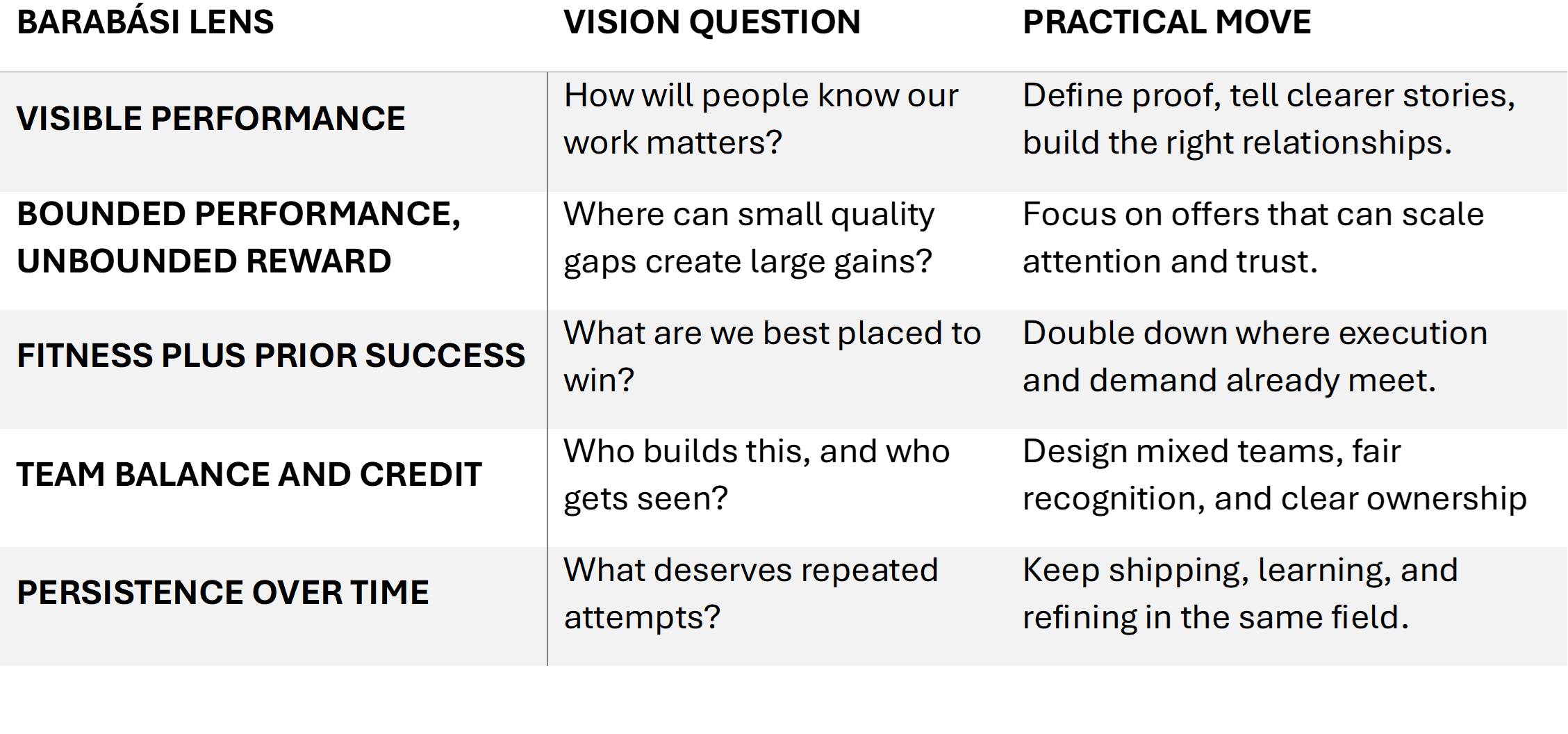
Table #1 - Barabasi’s laws - an interpretation
This turns vision into an operating rule. If a new project improves fit, visibility, fair teamwork, or steady output, it deserves attention. If it does not, it is probably noise.
You also need language people can repeat. If staff, customers, and partners all describe your organisation differently, the vision is not ready. That is where Pitch to Convince becomes useful. Clear vision and clear messaging are close cousins.
Barabási does not offer a neat recipe for fame. He gives you something better. He shows where success tends to come from, and where an organisation can improve its odds without fooling itself.
A vision people can believe in.
Founders often treat vision as a statement of intent. Barabási's laws push you to treat it as a set of conditions. Good work must be seen, fit must stay sharp, teams need balance, and progress needs repeated attempts.
That makes vision less dreamy and more useful. It becomes a guide for focus, structure, and patience when results are slow.
A Founder's Formula for Vision
In summary:
Vision = Purpose × Community × Narrative × Momentum
Where:
• Purpose gives direction.
• Community gives meaning.
• Narrative gives visibility.
• Momentum creates preferential attachment.
If any one of these is zero, the vision struggles.
For The Weave, it feels more alive because much of our work already assumes that founders do not succeed alone. The document's core idea—"Success isn't about you. It's about us"— serves as the philosophical foundation for our entire ecosystem.
A vision built on the universal laws of success is therefore not a declaration of what an organisation wants to become.
It is a declaration of the future community it intends to make possible.
The Weave’s vision, founded on these success laws, might look something like:
To create a world where every founder has access to the people, knowledge and support they need to thrive, ensuring that entrepreneurial success becomes something communities create together rather than individuals pursue alone.
If you want to build that kind of clarity with other founders, join The Weave.
