
Many entrepreneurs don't begin with a polished plan. They begin with a pattern they've seen up close, often for years.
Your history is not baggage. It's often the first real data set you have. Career turns, hard jobs, personal setbacks, and time spent inside broken systems can show you where people struggle and what still needs fixing.
What feels ordinary to you may be the insight someone else would pay a fortune to uncover. That's why lived experience deserves a closer look before you dismiss it and move on.
Your personal trajectory shows you problems other people miss
A founder's past is less a scrapbook and more a map. It shows where you've been close enough to notice friction, delay, waste, fear, confusion, or poor service. Market reports can hint at these things, but daily exposure lets you feel them.
That closeness matters. When you've sat in the waiting room, handled the paperwork, chased the answer, or dealt with the bottleneck yourself, you notice what others skip. You also build a sharper instinct. Not a perfect instinct, but a grounded instinct.
This is why some of the best startups come from people who have crossed more than one world. A researcher who later works in industry often sees both the promise of an idea and the slow path that keeps it from reaching people. A specialist who moves into commercial work learns how money, incentives, timing, and delivery shape what gets built. That mix helps founders ask better questions and make better choices.

Ask better questions
Repeated contact with a problem often matters more than one dramatic moment. You don't need a lightning bolt. You need enough exposure to see the same pain point recur in slightly different forms.
The issue that keeps irritating you may be the one you're best placed to solve.
The moments that frustrate you may lead to your best business idea
Frustration gets a bad name, yet it can be useful. If the same thing keeps slowing people down, your annoyance may be a signal rather than a mood.
Many entrepreneurs start there. They see talented people blocked by poor systems. They watch good ideas stall because no one owns the messy middle. They notice services built around internal convenience rather than human need. After a while, that stops feeling like "how things are" and becomes a problem worth naming.
This is common in sectors where progress should move faster than it does. In research, healthcare, education, finance, and public services, the gap between what is possible and what reaches people can feel painful. Funding may dry up. Teams may work towards different aims. Incentives may reward safety over usefulness when you've seen that from the inside, you stop speaking in theory.
That doesn't mean every frustration should become a company. Some are too narrow. Some belong to a single employer rather than to a wider market. Still, recurring friction is worth testing. If a problem keeps showing up across teams, roles, or organisations, you may be looking at the seed of a startup.
Seeing the human side of a problem gives your idea real purpose
Empathy is not soft thinking. It's one of the strongest business tools a founder can have.
When you've seen the human cost of a poor process, your work changes shape. A missed diagnosis, a delayed referral, a confusing form, a broken handover, an abandoned customer, these are not abstract faults. They affect real lives. That makes your motivation harder to shake when building gets slow.
This is where lived experience can turn ambition into urgency. An entrepreneur who has met the person on the receiving end of failure carries a different kind of energy. The goal stops being "launch something interesting". It becomes "remove this blockage because people pay for it in time, stress, health, or lost chance".
That kind of purpose also keeps founders honest. It can stop you from building features that look clever but solve little. It can help you stay close to the user's reality, even when investors, colleagues, or the market push you towards easier stories. If you're building for people, not for applause, your judgment often improves.
Reflective practice helps you turn experience into better choices
Experience on its own is not enough. You can live through a lot and still learn the wrong lesson. That's why reflective practice matters.
Reflection is not navel-gazing. It's a disciplined pause. You review key moments in work and life, then ask what they taught you, what they changed, and what you may still be missing. Without that pause, founders often react in narrow ways. They frame decisions as stay or go, raise or don't raise, build or stop. Real life is rarely that neat.

Journal, or use FounderThrive App to record
Reflective practice gives you a wider lens. It helps you spot patterns in your own choices. It shows which environment brings out your best work and which drains it. It also helps cofounders speak with greater care because they can trace their views to their sources.
For startup leaders, this matters as much as strategy. Better decisions usually come from better framing. If you want support while building those habits, a mental well-being tool for entrepreneurs can help create the space to think clearly under pressure.
Ask wider questions, not just should I do this or that. ”
Binary questions feel clean, but they often trap people. "Should I stay in my job or quit?" is too small. "Should I remain in academia or move into industry?" may also miss the point.
A better set of questions opens the picture. Given the situation you're in, what can you see from your own place and from the places of others? Which options are open right now, not in fantasy? Which route best fits the change you want to create? What evidence do you still need before moving?
These questions slow you down in a good way. They reduce panic. They also stop you from treating one identity as morally pure and another as a compromise. Moving from research to industry, or from employment to a startup, is not a betrayal of purpose. In many cases, it's a practical response to what you've witnessed first-hand. Sometimes the fastest way to help people is to work where ideas can be funded, shipped, tested, and scaled.
This wider lens also improves conversations with founders. Cofounders often disagree because they are solving different versions of the same problem. Reflection helps surface that early.
Use each turning point as a chance to test your direction
Career crossroads can feel dramatic, but they don't need dramatic answers. A turning point is often a checkpoint, not a cliff edge.
After a tough project, a failed pitch, a poor hire, or an unexpected offer, stop and review what changed. Which assumption no longer holds? What strength showed up under pressure? Which part of the work gave you energy, and which part pulled you off course?
Then test, don't guess. A short pilot, a customer-interview round, a part-time advisory role, or a limited product trial can tell you more than six months of worrying would. Startups rarely reward grand gestures. They reward informed movement.
If you're building in public or alongside peers, it also helps to connect and collaborate with entrepreneurs who can challenge your blind spots. Reflection gets stronger when you pair it with an outside perspective.
Career change is normal, so build a framework you can return to.
Few careers now move in a straight line. Founders shift sectors, business models, and roles more often than past generations did. That is not a flaw. It's the shape of modern work.
The answer is not to cling to one label. It's to build a framework you can reuse whenever change arrives. That matters for cofounders moving between academia, industry, corporate roles, consulting, freelancing, and startups. Each move gives new information. The goal is to turn that information into better judgment.

You are at a crossroads
People often treat movement as a sign of uncertainty. In truth, movement between sectors can sharpen innovation. Someone who has worked across boundaries usually sees more clearly where ideas get lost, where incentives clash, and where value can be created.
A good framework helps you move with confidence, not fear.
You don't need a complex model. You need one you will use when things get messy. A simple framework and a visual metaphor, our PISA model, serves as a reminder that bias exists and that taking a different perspective can shift the nature of the leaning. As a framework, it builds situational confidence and helps you connect to a series of prompts.
P is for Pause - Notice the signals that keep appearing, and widen the view beyond your own.
I is for Inspect - Name the problem in plain language and then map the real options in front of you.
S is for Sense – What feels right, not just for you but for others. Test out what matters
A is for Align - Review what happened, adjust your approach to accommodate others, and build in actions that benefit from collaboration.
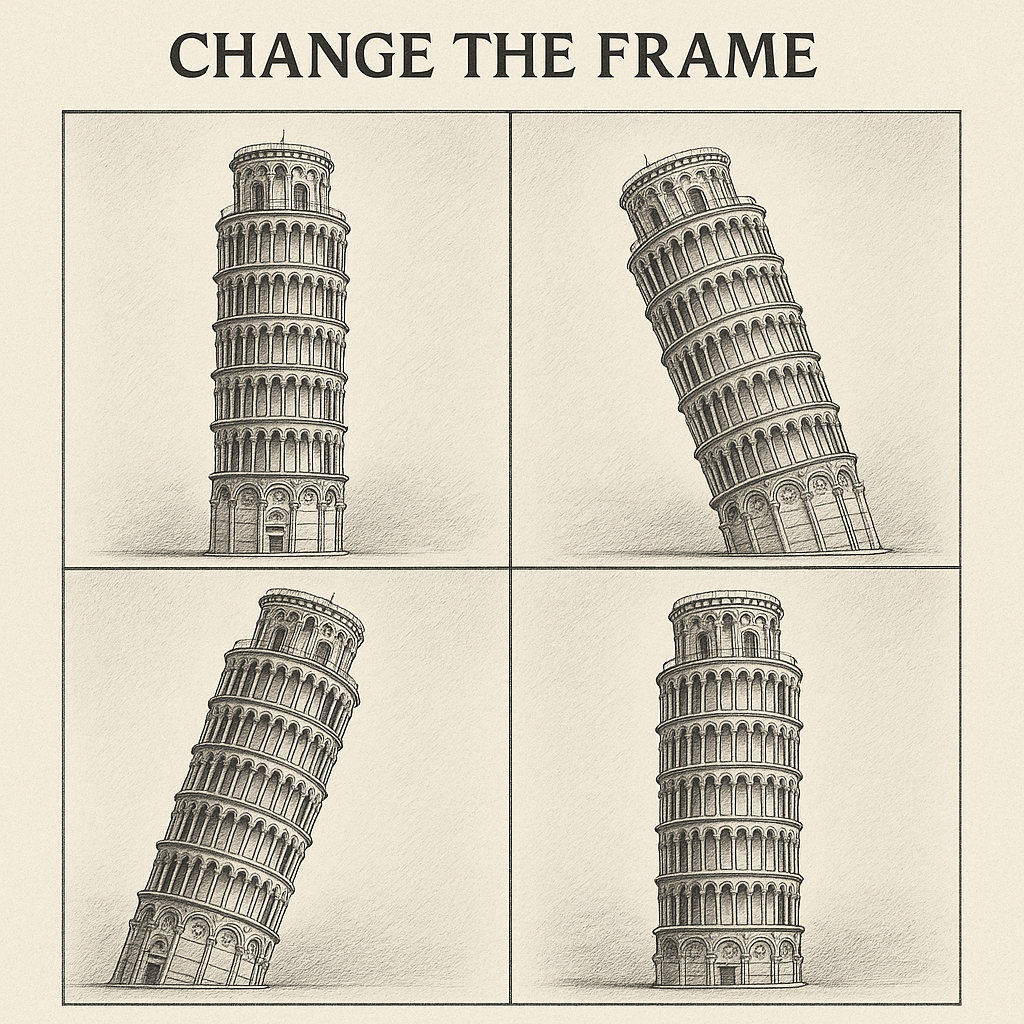
Change the perspective and change the bias
This prevents two common founder mistakes. First, it stops you from calling every change a crisis. Second, it keeps you from romanticising your own story. Not every hard experience leads to a business. But every hard experience can teach you something useful about fit, timing, and need.
The framework also supports movement between worlds. If you leave a lab for a commercial team or step out of a startup into a larger firm, you can carry the same decision-making method with you. That consistency builds confidence because your process stays steady even when your title changes.
Your path can create value by connecting insight, empathy, and action.
The strongest business ideas often sit at the meeting point of three things: insight into the system, empathy for the people inside it, and the willingness to act.
That is why lived experience matters so much for entrepreneurs. It joins what you've seen with what you can do next. It also helps clear up an old misunderstanding. Starting a business is not a rejection of purpose. For many founders, it's the most honest response to a problem they could no longer ignore.
When people move between sectors and share what they've learned, everyone benefits. Research becomes more connected to use. Commercial work becomes more grounded in real need. Startups get better questions early, which often means fewer costly mistakes later.
Your past is usable knowledge.
The pattern you have lived through may be the clue your next venture needs. What you've seen, felt, and worked around is not just backstory. It's evidence, direction, and energy.
Treat each touch point as data. Reflect on it, widen the question, and test the next move with care.
If you're building something now, ask yourself this: which problem have you been close to for so long that you've stopped noticing how much you understand it? That answer may be where your best work begins.
